
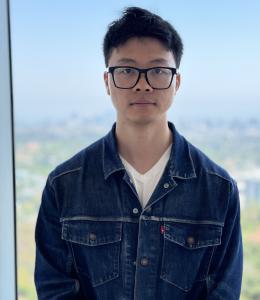
Dr Sha Huang
IASH-National Museums Scotland Postdoctoral Fellow, September 2026– February 2027
Sha works at the intersection of game studies, digital cultural heritage, human-computer interaction, and museum engagement, bringing together tools and perspectives from art, media, design, and technology into a single interdisciplinary practice. As an IASH Postdoctoral Fellow at the University of Edinburgh, he collaborates with National Museums Scotland to explore how games can foster visitor engagement and meaningful encounters with cultural heritage.
His PhD in Fine Arts from Texas Tech University was itself an interdisciplinary undertaking, developed in close collaboration with researchers in the College of Media and Communication on HCI projects that bridged artistic practice and communication research. This cross-disciplinary foundation continues to shape his broader inquiry into how cultural knowledge is translated, organized, and experienced through interactive systems, and the simplifications, power relations, authorship questions, and ethical challenges that digitization raises.
While rooted in game studies, he approaches games not as a fixed discipline but as a flexible medium that travels across sectors, museums, education, cultural institutions, and public engagement, linking critical cultural research with interaction design and creative technological practice.
His path into academia was equally varied: before pursuing research, he worked in media and advertising, and while living in New York, gained hands-on experience in interior design and web design. This blend of artistic, technical, and commercial experience continues to inform how he approaches research, collaboration, and the design of public-facing cultural experiences, always moving fluidly between disciplines rather than staying within one.
Project title: A Transferable Pilot Workflow for Community-Responsive Digital Cultural Heritage Using Hmong Batik
Digital cultural heritage projects often preserve visual records while separating cultural forms from the practices and relationships that give them meaning. This six-month pilot project develops a community-responsive workflow for documenting and interpreting living heritage in museum settings, using Hmong batik as a case study. In collaboration with National Museums Scotland, the project asks how culturally bounded knowledge can be represented in digital form without reducing it to decorative imagery or unrestricted content.
The study will first develop a pilot dataset schema that records motifs in relation to making processes, object histories, interpretive context, permissions, and areas of uncertainty. Selected museum materials will then be used to build a small game-based demonstrator. Rather than presenting batik motifs as collectible visual assets, the prototype will allow visitors to encounter how meanings emerge through practice and cultural context. Its interaction design will also make visible where access is limited, why some material requires explanation, and why certain knowledge should not be transformed into gameplay.
The prototype will be evaluated through guided interaction sessions and qualitative feedback from museum staff, visitors, and community-informed contributors where feasible. The evaluation will focus on whether the experience improves understanding of Hmong batik as living, process-based heritage and whether it communicates interpretive boundaries clearly.
The project will produce a tested dataset schema, a documented prototype, and practical guidance for future museum projects. Its main contribution is a transferable method for responsibly using games as interpretive interfaces while recognizing that cultural meaning itself cannot be transferred without limits.