
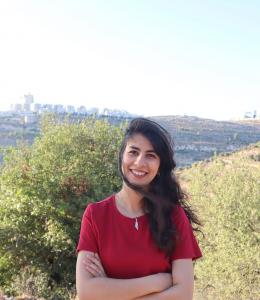
Dr Manal Shqair
GENDER.ED Postdoctoral Research Fellow, September 2026 - June 2027
Dr. Manal Shqair is an activist scholar from Palestine. She holds a PhD in Sociology from Queen Margaret University. Manal’s scholarly work focuses on settler colonialism, ‘everyday’ resistance, and environmental colonialism and justice in Palestine and the wider Arab region. Her research also engages with the sociology of gender and Ibn Khaldun’s theory of social cohesion. Manal’s research has been published or is forthcoming with Pluto Press and in Global Perspectives, PRISME - Pathways to Renewed and Inclusive Security in the Middle East, Community Development Journal, Transnational Institute and Transactions of the JNF. She has written shorter pieces for Vittles Magazine, Middle East Eye, Al Jazeera, Jacobin Magazine, Scottish Graduate School for Arts & Humanities and 7iber.
Project title: Palestinian Women’s Eco-Sumud: Nomadism, Settler Colonialism and Environmentalism
While at IASH, I will be working on a book manuscript based on my doctoral study, drawing on ethnographic data to examine semi-nomadic women’s everyday forms of resistance as modes of (eco-)sumud (eco-steadfastness) in Masafer Yatta, southern Palestine. Eco-sumud refers to a repertoire of traditional knowledge, land-based cultural values, and social relations utilized for anti-colonial resistance, including maintaining and reinvigorating a sustainable relationship with the non-human world. It pinpoints the intertwinement between decolonialisation and environmental and gender justice in Palestine. Examined from an anti-domicidal lens, eco-sumud offers a new understanding of the domestic/familial as part of a broader framework of kinship, egalitarianism, and reciprocity between the human and the non-human. The term reflects the adaptability of indigenous modes of livelihood like semi-nomadism to changes in Israel’s political ecology of dispossession.
The study takes an interdisciplinary approach, integrating insights from resistance studies, settler colonial studies, Indigenous studies, (eco-)feminism, and Marxist theories of movement formation. It also engages J.D. Porteous’ and S.E. Smith’s (2001) concept of “domicide” to analyse Israeli settler-colonial formations as an attack on Palestinian localities constituting the private home sphere and the homeland. The study contributes significant insights to resistance studies on the centrality of gender, alongside class/lifestyle and race to articulations of oppressed groups’ resistance beyond the realm of invisible, passive, and accommodative politics.
The book focuses on the following themes: the centrality of domesticity to eco-sumud and possibilities for eco-sumud after October 2023. It reconceptualises prevailing understandings of ‘everyday’ resistance through an intersectional environmental lens in the articulation of eco-sumud. Amid insufficient scholarly attention to a gendered ecological perspective of Palestinian liberation, my study contributes significant insights into developing an overarching conceptual framework to understand the centrality of ecological and cultural lifeways for anticolonial resistance.