
A guest blog by Dr Emrah Atasoy:
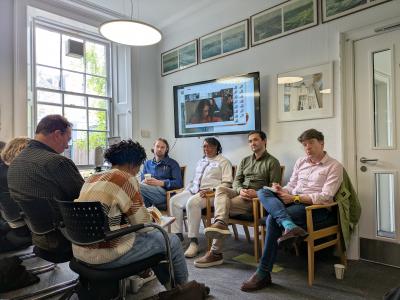
The interdisciplinary panel ‘Narratives of the Future,’ organised by Dr Emrah Atasoy and generously hosted by IASH, explored how the future is imagined through literary, cultural, and political perspectives, and how such narratives shape our understanding of contemporary global challenges. Bringing together four speakers, the panel addressed different approaches to envisioning the future and the ways in which these perspectives influence our interpretations of tomorrow. Focusing on insights from literary studies, cultural studies, and political theory, the discussion highlighted the contributions these fields can make to ongoing debates about the future and the complex issues facing the world today. The panel was moderated by Professor Anna Vaninskaya (School of Literatures, Languages and Cultures, University of Edinburgh), and featured presentations by Professor Mathias Thaler (School of Social and Political Science, University of Edinburgh and former IASH Fellow), Dr Jarita Holbrook (School of Social and Political Science, University of Edinburgh and former IASH Fellow), Dr Emrah Atasoy (current Fellow at IASH), and Dr Owen Holland (School of Literatures, Languages and Cultures, University of Edinburgh).
Professor Thaler addressed themes of climate change and denialism, the internally diverse nature of the transition paradigm, and conceptualised the Anthropocene as an interregnum. Dr Holbrook explored Afrofuturism, including perspectives on space in Africa, cultural astronomy, engagement with outer space, and key elements of Afrofuturistic writing, such as representations of futures in which Black people thrive. Dr Atasoy examined the representation of the future in utopian and dystopian narratives from a literary perspective, offering an overview of utopianism, utopia, and dystopia, alongside a critical reading of Alfonso Cuarón’s Children of Men (2006). Dr Holland discussed Edward Carpenter’s Towards Democracy, focusing on Carpenter’s anti-political orientation towards the future and his portrayal of utopianism.
Collectively, the presentations opened an interdisciplinary dialogue on how the future is imagined, interpreted, and represented across literary and cultural narratives, and how these visions shape understandings of contemporary global complexities. The panel highlighted the importance of interdisciplinary collaboration in addressing today’s multifaceted challenges. The presentations were followed by a 20-minute tea and coffee break, after which a lively 30-minute Q&A session was held, moderated by Professor Vaninskaya, with questions from both in-person and online participants. The event was well attended, with approximately 25 in-person and 55 online attendees.
Image by Dr Emily Clifford.