
The Digital Museum of Sufi Stories and Art by Children and Families: A Growing, Living Archive of Sufi Storytelling within Family Life
What happens when children and families actively bring centuries-old literary and cultural traditions to life through storytelling practices? What might we learn when stories are understood as historical artefacts as well as living practices of family life?
The Digital Museum of Sufi Stories and Art by Children and Families offers one way of thinking about these questions. Emerging from the Sufi Storytelling Project conducted by Dr Hamide Elif Üzümcü, the Digital Museum presents a public engagement exhibition that brings together children's creative work and family narratives around Sufi stories, concepts, and ways of seeing the world.
The Sufi Storytelling Project investigates how children and families within the Sufi tradition in the United Kingdom construct environmental ethics through Islamic storytelling. Sufism (tasawwuf), a mystical and esoteric Islam, offers an ‘ethics of the environment,’ that considers environment as reflection of the Oneness of Being (tawhid) (Zarcone, 2005). This view of the environment is often negotiated by families and children within Sufi traditions, through the Islamic culture of storytelling (Irawan et al., 2022; Zargar, 2017).
The project aims to document the living cultural narrative heritage of Sufism as part of the everyday lives of families in the UK and propose Sufism’s holistic understanding of the environment as a theoretical alternative, challenging Western-centric perspectives on conceptualising environmental relationships, supported by empirical evidence from everyday family life. It employs narrative interviews with children and parents (Gubrium and Holstein, 2012) as well as story-design workshops with children (Guthrie, 2022).
Hosted by the Institute for Advanced Studies in the Humanities (IASH), the Digital Museum of Sufi Stories and Art by Children and Families brings together two collections:
1) the Children's Digital Museum of Sufi Stories and Art
2) the Family Archive of Sufi Narratives
Together, these collections create something more than a repository of research data. They form a growing, living archive in which stories are preserved as well as continue to carry meanings across generations.
Children as storytellers
The Children's Digital Museum of Sufi Stories and Art presents a curated collection of contemporary artworks produced by children and young people through Story-Design workshops. These workshops were conducted individually with young participants aged 12–15 who were raised by parents following a Sufi tradition. Each workshop began with warm-up storytelling activities based on a Sufi literary text addressing environmental themes. The young participants were then invited to write or design their own stories exploring Sufi approaches to the environment.
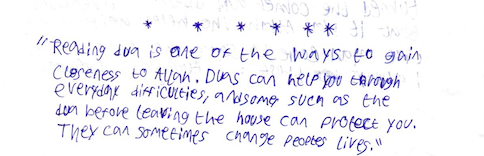
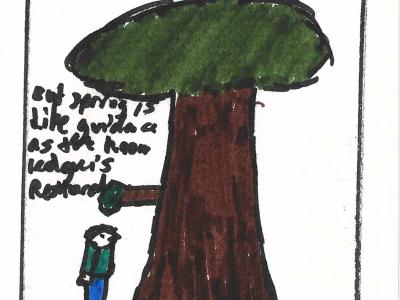
Image 1: Excerpt from the ‘Untitled Story’ by Participant A (Boy, Age 12)
Each archived item includes the story, the storyteller's reflective notes, themes, citation information, and copyright and licence statements. The artworks are also archived in DataShare, the University of Edinburgh's repository, with a separate DOI assigned to each artwork created by the children.
This process gives children's creative contributions a life beyond the workshop itself. They become part of an accessible research and cultural archive.
Sufi stories in family life as living heritage
The second collection, the Family Archive of Sufi Narratives, approaches storytelling from another direction. It documents centuries-old Sufi stories shared within family life, along with the contexts through which these stories are passed on and experienced.
The archive draws on narrative interviews with parents and their children. It includes a dataset from 12 parents and 8 children aged 12 to 15, organised into two collections: (1) Sufi Stories, comprising 55 stories, and (2) Sufi Concepts, comprising 30 concepts.
These collections are archived in ReShare, the UK Data Service’s repository, creating a national record of contemporary representations of Sufi families in the UK, both for secondary data analysis and as a public engagement output in an easily accessible format.
Each item records the story itself as well as the pseudonymised information about the storyteller, the date and place of collection, the storytelling context, moral and ethical teachings identified by the storyteller, the source tradition, keywords an archival citation for referencing the story.
The significance of this collection lies partly in its attention to Sufi storytelling as an intergenerational practice across the UK. The archive makes the processes and contexts of Sufi practices visible in contemporary Britain.
From archive to living archive
The word archive can sometimes suggest something static; a collection of materials preserved from the past. The Digital Museum invites us to think differently.
The stories and artworks gathered here are part of an ongoing process of cultural practices. The archive is “living” because its materials remain connected to the social relationships and experiences through which they have been produced throughout the Sufi history to today.
This is particularly significant when thinking about intangible cultural heritage. Sufi practices, including gatherings, festivals, theatres, music continue to be practised including homes, madrasas, mosques, tekkes (Sufi lodges) connected to a new generation's experiences.
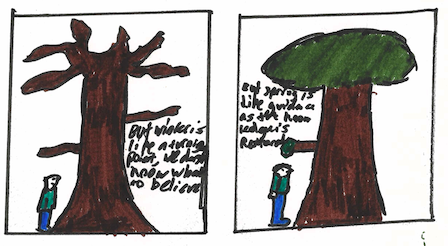
Image 2: Excerpt from the comic ‘Tree of Mankind’ by Participant C (Boy, Age 13)
Both the Children’s Digital Museum of Sufi Stories and Art and the Family Archive of Sufi Narratives make visible children raised within Sufi traditions as active storytellers.
Making research visible beyond the university
The Digital Museum of Sufi Stories and Art by Children and Families is an example of how research involving children and families can extend beyond academic publications, research reports, and institutional archives. The museum creates another possibility: transforming research participants’ contributions into a public cultural resource.
The Digital Museum also creates new possibilities for public engagement, cultural heritage, future research, and teaching. It enables research findings to be shared beyond academia in an accessible and engaging format, highlighting contemporary Sufi cultural and literary traditions in the lives of children and families within a majority non-Muslim Western society.
The collection can also be reused for secondary data analysis and serve as a teaching resource, offering materials for exploring childhood, belief systems, cultural heritage, family life, intergenerational storytelling practices and environmental ethics.
Explore the Digital Museum of Sufi Stories and Art by Children and Families
Discover the stories, children’s creative works, and family narratives in the Digital Museum using the link below or scan the QR code:
https://www.iash.ed.ac.uk/digital-museum-sufi-stories-and-art-children-and-families

Acknowledgements
This research project is funded by the Alwaleed Centre for the Study of Islam in the Contemporary World and the Institute for Advanced Studies in the Humanities (IASH), the University of Edinburgh, and by the TÜBİTAK 2219 International Postdoctoral Fellowship of the Scientific and Technological Research Council of Türkiye.
Special thanks to Dr Ben Fletcher-Watson, Deputy Director of IASH, for developing this museum on the IASH website. Sincere thanks are extended to Dr Kholoud Al-Ajarma, Alwaleed Lecturer in the Globalised Muslim World and Deputy Director of the Alwaleed Centre, for her valuable mentorship throughout the project. With gratitude to the participating parents, children, and young people for their time, active engagement with the project and meaningful contributions.
The researcher is registered with the Protection of Vulnerable Groups (PVG) Scheme in compliance with Scottish Government requirements for working with children. Ethical approval for the research was granted by the Ethics Committee of the Department of Literatures, Languages and Cultures (LLC) at the University of Edinburgh. Informed consent was obtained from all participating children and their parents/carers.
About the author
Dr Hamide Elif Üzümcü is a TÜBİTAK 2219 International Postdoctoral Fellow & Associate Fellow (2026) at the Alwaleed Centre for the Study of Islam in the Contemporary World and Nominated Fellow (2026) at the Institute for Advanced Studies in the Humanities (IASH) at the University of Edinburgh. Elif is also an Assistant Professor in the Department of Sociology at the Social Sciences University of Ankara in Türkiye.
References
Gubrium, J. F., & Holstein, J. A. (2012). Narrative practice and the transformation of interview subjectivity. In J. F. Gubrium, J. A. Holstein, et al. (Eds.), The SAGE handbook of interview research: The complexity of the craft (pp. 27–44). Sage.
Guthrie, K. (2022). (Re)fractional narrative inquiry: A methodological adaptation for exploring stories. Methodological Innovations, 15(1), 3–15.
Irawan, B., Latif, M. S. A., & Nasution, I. F. A. (2022). Green Sufism argument as environmental ethics. Religia, 25(1), 82-95.
Zarcone, T. (2005). Stone people, tree people and animal people in Turkic Asia and Eastern Europe. Diogenes, 52(3), 35–46.
Zargar, C. A. (2017). The polished mirror: Storytelling and the pursuit of virtue in Islamic philosophy and Sufism. Oneworld Publications.
Contact
For further information, please contact Dr Hamide Elif Üzümcü at hamideelif.uzumcu@ed.ac.uk