
Please note that this event is on Thursday 28 April, not our usual Wednesday seminar time.
An IASH Work-in-Progress seminar, delivered by Dr Rachael Scally (Daiches-Manning Memorial Fellowship in 18th Century Scottish Studies 2021-22):
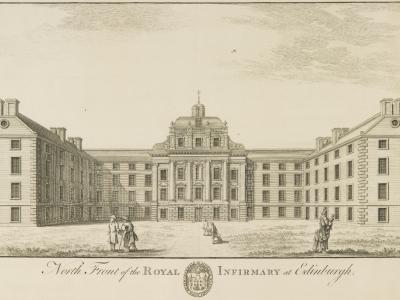
The Early Years of the Edinburgh Royal Infirmary and the University of Edinburgh Medical School: Philanthropy, Medicine and Slavery in Long Eighteenth-Century Scotland
As commentators such as Stephen Mullen and Michael Morris have argued, Scotland has been guilty of ignoring its participation in slavery, violence, and an empire in which all people were far free or equal. For many years slavery was traditionally seen as something that happened only elsewhere, far beyond Scottish shores, in the cotton fields of the South or the sugar plantations of the Caribbean. Instead, like England and Ireland, Scotland preferred to remember its country’s prouder historical events and achievements, such as its role in the abolition of the slave trade and the Scottish Enlightenment. Since the murder of George Floyd in May 2020, the Black Lives Matter movement has gathered pace and people throughout the UK, Ireland and the world have begun to confront and reflect on how their towns, cities and institutions owe a debt to slavery. This talk aims to contribute to such work by shedding light on Edinburgh’s complex institutional relationship to slavery, thereby making a modest contribution to the understanding of Scottish, British and global history.
The paper will discuss the early years of the Edinburgh Royal Infirmary and the University of Edinburgh Medical School, examining their philanthropic and wider entanglements with transatlantic slavery. The development of the Infirmary will be situated within the wider context of Scotland’s eighteenth-century medical world, focusing on the inauguration of the University of Edinburgh’s Medical School and its own unquestionable relationship to transatlantic slavery. It will then investigate the foundational years of the Infirmary, examining to what extent financial gifts and support came from donors who derived either some or, in a few instances, much of their wealth from slavery and the trade in slave produced goods. It will turn its searchlights on the Infirmary’s network of wealthy contacts and donors, discussing particularly those in London and the British Caribbean. It will demonstrate how the Infirmary owned enslaved people and benefitted financially from their labour. It hopes to point the way forward for similar research, highlight opportunities for future study, and encourage informed debate more broadly on the legacies of slavery.
Please click the link below to join the webinar:
https://ed-ac-uk.zoom.us/j/85635833799
Passcode: d22aCHWx